Tired of identity management headaches?
Privileged Access Management (PAM)
Protect access to your sensitive accounts with Soffid PAM. Monitor, control, and audit access to privileged accounts in your organisation. Increase security, reduce risk, and ensure regulatory compliance.
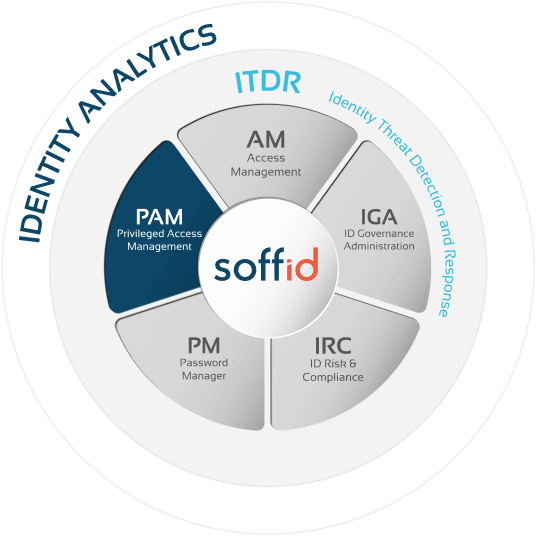
Privileged account management is crucial when you need to protect your company’s most sensitive resources
Soffid Privileged Access Management (PAM) offers you an advanced solution to control, audit, and protect access to these sensitive accounts and assets, ensuring that only authorised users can access sensitive resources.
Complete control over privileged access:
Ensures that only approved users have access to sensitive resources.
Advanced security:
Monitor sessions in real-time, detect risks, and protect privileged credentials with cutting-edge technology.
Continuous auditing:
Records all actions performed on privileged accounts, enhancing traceability.
Regulatory compliance:
Ensures that all access policies are adhered to, enhancing security and compliance.
Soffid PAM provides advanced features to manage and protect access to privileged accounts:
Monitors sessions in real time to quickly identify abnormal behaviour or suspicious access activity.
Adds an extra security level to tighten access control and further protect your data and systems. A decisive measure against unauthorised access.
Logs all activity performed on privileged accounts and delivers accurate reporting to ensure control and accountability.
Protect your SaaS services, cloud applications, on-site applications and network devices with Soffid PAM.
Privileged Account Management:
Detect, track, and automatically manage all privileged accounts, reducing risks by ensuring that no privileged account goes unmonitored.
Grant access as and when required and revoke it when it is no longer needed.
Increases security by requiring multi-level approvals for access to sensitive resources, granting privileged access only when needed.
Soffid PAM provides real-time monitoring and session recording, including event and action auditing.
Proactively monitors and prevents unauthorised actions in real-time using a set of security rules to stop unauthorised actions, block malicious or suspicious accounts, and generate incident reports.
Soffid PAM manages different types of sensitive accounts, from internal users through to non-human applications and services:
Users with access to sensitive configurations and resources.
Services, applications, and APIs with privileged access to resources.
Access by suppliers and contractors with special privileges.

Soffid PAM solves several common issues in privileged account management:
Ensures that only authorised users access sensitive accounts, thereby strengthening security.
Provides complete visibility into all actions performed within privileged accounts.
Ensures full compliance regarding security policies and regulations, minimising risks and strengthening regulatory confidence.

With Soffid, you have the flexibility to implement our solutions on your own servers (On Premise) or with a cloud-based solution (On Cloud), depending on your infrastructure needs and security preferences.
Soffid Privileged Access Management (PAM) adapts to a wide range of industries, offering customised solutions to protect access to privileged accounts in different sectors:
Discover how companies from a wide range of industries have successfully transformed their security and identity management with Soffid solutions. Check out the success stories that illustrate how we can help you achieve your goals.







Request a free demo or a free trial and discover how Soffid PAM can improve security and compliance in your business.
Access articles that are relevant to your industry and find out how our solutions can transform your digital infrastructure.
Soffid participated in the @aslan Association’s “Cybersecurity & AI” Trends 2026 Forum, where Gabriel Buades, Founder and CTO of Soffid, discussed the role of identity management as the foundation of IT security in a context shaped by AI, cyberresilience, and the disappearance of the traditional perimeter.
At Soffid, we took part in the ASLAN 2026 Congress & EXPO as sponsors of the ASLAN Association Awards for Digital Transformation in Public Administration. In addition, Gabriel Buades gave a presentation on how digital identity and artificial intelligence can turn security policies into real, automated controls.
Here’s what RSAC 2026 looked like for Soffid: a few intense days in San Francisco connecting with the cybersecurity ecosystem, exchanging ideas, and reinforcing key conversations around identity security, access governance, and resilience in hybrid and cloud environments, together with the Spain Pavilion alongside ICEX + INCIBE.
Soffid participated in the @aslan Association’s “Cybersecurity & AI” Trends 2026 Forum, where Gabriel Buades, Founder and CTO of Soffid, discussed the role of identity management as the foundation of IT security in a context shaped by AI, cyberresilience, and the disappearance of the traditional perimeter.
At Soffid, we took part in the ASLAN 2026 Congress & EXPO as sponsors of the ASLAN Association Awards for Digital Transformation in Public Administration. In addition, Gabriel Buades gave a presentation on how digital identity and artificial intelligence can turn security policies into real, automated controls.
Here’s what RSAC 2026 looked like for Soffid: a few intense days in San Francisco connecting with the cybersecurity ecosystem, exchanging ideas, and reinforcing key conversations around identity security, access governance, and resilience in hybrid and cloud environments, together with the Spain Pavilion alongside ICEX + INCIBE.
Learn how Identity and Access Management strengthens security, prevents fraud, and improves user experience in e-commerce and digital business environments with Soffid IAM.
A guide on how advanced IAM solutions enable financial organizations to protect identities, prevent fraud, and maintain compliance without impacting operations.
Discover how CIE Automotive strengthened security, regulatory compliance, and operational efficiency across its industrial plants with a centralized IAM strategy powered by Soffid.
At Soffid, every conversation can lead to a tailor-made solution
A password vault stores and rotates admin credentials but stops there; PAM adds session brokering and recording, just-in-time access grants (privileged rights issued only for the duration needed, then revoked), and approval workflows around who gets privileged access and when. "Privileged identity management" is generally used interchangeably with PAM by most vendors rather than denoting a genuinely separate category. If your current setup is "a shared vault everyone checks a password out of," you have credential storage, not the access control, session oversight, and time-bounding that PAM specifically adds on top.
Traditional PAM pricing and infrastructure requirements were built around large-enterprise deployments — dedicated servers, extensive professional services, licensing tiers assuming thousands of privileged accounts — which is why it's earned a reputation as out of reach for mid-sized companies. Soffid's PAM is delivered as a module of the same converged platform rather than a separately-priced, separately-architected product, which avoids the standalone infrastructure overhead that drives up cost for smaller deployments. Cost still scales with the number of privileged accounts and systems you need to cover, so get a quote scoped to your actual privileged account count rather than assuming enterprise list pricing applies to your size.
Because Soffid's PAM runs as a module within the same platform rather than a bolt-on requiring its own dedicated servers, you avoid the separate hardware provisioning step that stretches out timelines for traditional standalone PAM tools. A focused first phase — vaulting and rotating credentials for your highest-risk admin accounts — can go live in weeks, while full coverage across every privileged account and session-recording policy is a longer, phased effort. The realistic path to fast value is scoping phase one narrowly (your riskiest accounts) rather than trying to onboard every privileged credential in the organization at once.
Session recording, just-in-time access, credential rotation, and secrets management for automation are the core capabilities most organizations genuinely use; advanced analytics dashboards and highly granular workflow customization are where unused feature bloat tends to accumulate. Because Soffid's PAM is modular within a converged platform, you're not forced to license a fixed enterprise bundle to get the core capabilities — scope the deployment to the specific privileged use cases you actually have (admin session control, service account rotation) rather than defaulting to every available feature.
Session recording captures privileged sessions (and optionally keystrokes) for defined account types, with retention periods and reviewer access configurable per policy — recordings aren't automatically visible to every admin, only to roles you designate for security review or incident investigation. Legally, monitoring employee sessions is subject to local labor and privacy law, and in several EU countries this requires works-council consultation or documented employee notice before deployment — that consultation is a legal requirement independent of which PAM product you use, and should happen before session recording goes live, not after.
The friction point is almost always non-interactive access — scripts, CI/CD pipelines, and service accounts that expect a static credential rather than a brokered, time-limited session. Soffid's PAM supports secrets management and API-based credential retrieval specifically so automation can request credentials programmatically instead of breaking when interactive session brokering is introduced. Expect to inventory and migrate hardcoded credentials in scripts and pipelines as a discrete piece of the rollout — that inventory work, not the PAM software itself, is usually what determines how much disruption sysadmins actually experience.
Soffid's PAM includes secrets management for service accounts, API keys, and automation credentials alongside human privileged-session control, with rotation and access policies that apply to both. Non-human identities need different lifecycle rules than human admins — a service account can't approve its own MFA step-up, for instance — so this is handled through API-based credential retrieval and ownership assignment (someone is accountable for each service account) rather than forcing machine identities through the same interactive workflow built for people.
Partial PAM coverage is a common real-world outcome, and it happens because onboarding every privileged account and system takes ongoing discovery effort that competes with other IT priorities after the initial go-live enthusiasm fades. The practical way to close this gap is treating privileged account discovery as a recurring process, not a one-time inventory at kickoff — new service accounts and admin credentials get created continuously, and without a standing process to catch them, coverage erodes over time even after a successful initial rollout.
The concrete thing to verify before deployment is whether vaulted credentials and configuration can be exported in a usable, non-proprietary format, since PAM vendors vary significantly here — some use proprietary vault formats that make migration to another tool a substantial re-entry project rather than a data export. Confirm Soffid's export capabilities for vaulted credentials, rotation policies, and access records specifically, since this is the part of a PAM deployment most likely to create real switching friction later, regardless of vendor.